
There Is An Old Story Of Psyche, Whose Name Means Soul. Let Us Settle Into The Story.
A Story Involving Desire: And The Ink Of Its Writ Is Appetite
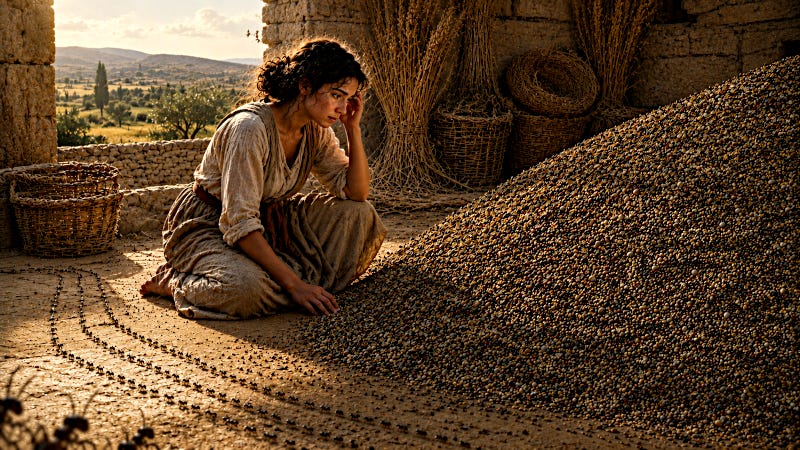
In the course of her awakening, Psyche is given an impossible task. Before her lies a great heap of seeds and grains — thousands of them, different kinds all thrown together. She is commanded to sort them, each according to its kind, before nightfall.
Psyche cannot do it. Then the ants arrive.
One by one, these smallest of creatures enter the bewildering heap and begin their work. Countless tiny intelligences accomplish what the individual mind cannot.
It is difficult for me not to see the body here.
We may consciously choose the food and lift it to the mouth, but beyond that threshold an extraordinary ordering begins without our instruction. Food is broken down, recognized, sorted, absorbed, transformed, relinquished.
We do not command this intelligence. We participate in it.
The heap looks chaotic only from a certain distance. Come closer, and something is sorting. And in the body, sorting is followed by transformation.
In yogic and Ayurvedic language, agni is fire, but not merely physical fire. Digestive fire is the transformative principle by which something arriving from outside us can be broken down, metabolized, assimilated — made available for life.
Psyche isn’t asked to conquer the heap. She isn’t asked to overpower it or impose something foreign upon it. She has to discern what is already there.
This is viveka: discernment, differentiation, the capacity to recognize one thing from another and enter into appropriate relationship with it. And this, too, is something the body is doing all the time.
The Intestines
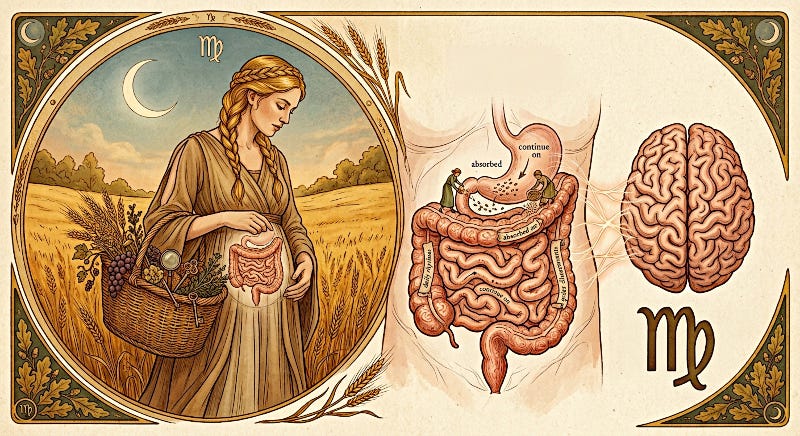
In Virgo season, I find myself drawn toward the small things: daily rhythms, hidden workings, the quiet discernments that shape a life.
Virgo carries the harvest basket. And Virgo has traditionally been associated with the intestines — that long interior terrain where the world is sorted into what may be absorbed and what must continue on.
The intestines themselves fold and convolute through the body, strangely reminiscent in form of the brain’s own folded terrain — as though intelligence, too, prefers a little more surface upon which to work.
There is something astonishing about digestion when we stop treating it as ordinary.
Long before we had names for enzymes, hormones, acids, microbes, membranes, the body was already performing its intricate work in darkness.
A meal enters us as matter and disappears into mystery. It is broken apart, moved along, met, transformed. Some of it crosses the intestinal boundary and enters circulation. Some becomes available for energy, repair, and the continual making of blood, bone and tissue. Some continues through us and is relinquished.
Science begins in observation. And sometimes scientific knowledge, rather than removing the mystery, makes the mystery more intimate.
Consider An Apple.
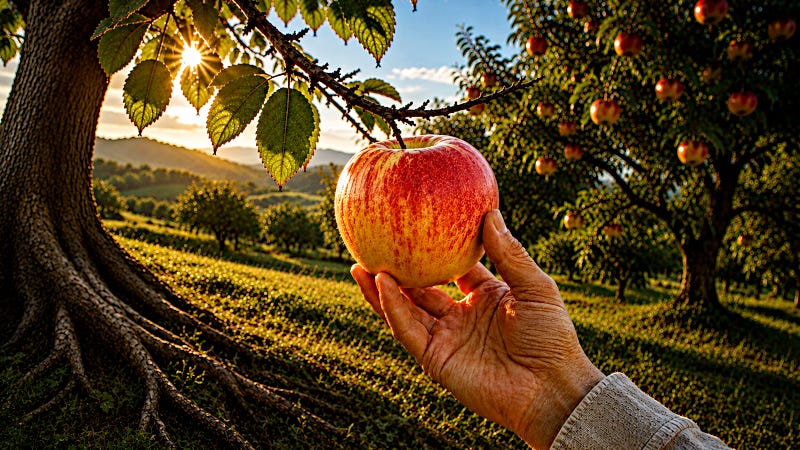
It Begins Outside The Boundary I Call Me.
Sunlight, Water, Minerals, Soil, Root, Leaf, Fruit.
I Lift It To My Mouth.
Hours later, something that belonged to that apple has crossed into my body and entered the processes by which this body continually remakes itself.
Where does not-self become self? Perhaps there is no single place where it happens. Perhaps the boundary is more alive than that.
Eating is an exchange between inner and outer nature: sunlight stored in leaf and fruit, minerals lifted from soil, rain drawn upward through root and branch, becoming for a little while the substance of a human life.
Sunlight → Leaf → Fruit → Mouth → Digestion → Molecule → Cell
The body does not merely receive the world. It interprets it. And we do not accomplish this through conscious effort. The ants do the work.
Countless processes — small intelligences, if you will — meet what arrives. There is poetry in this precision.
Digestion is one of life’s oldest expressions of intelligence.
The First Harvest Basket
My own relationship with food began close to the earth. I was born into a world of small family farms, where food wasn’t yet something I thought of as “organic.” It was simply food.
Animals grazed. Vegetables ripened according to season. Things were pulled from the earth and brought to the table. And what could not be eaten fresh was stored, preserved, and put by for winter. That was my first imprint.
Then, like many of my generation, I entered another food world. Coke and Pepsi became ordinary companions. There was coffee at too young an age, candy in abundance, bright packages and foods increasingly removed from anything I recognized as field, orchard, animal, root.
I didn’t have language for this transition then. I only lived it.
Years later, in my twenties, I found myself moving back toward the foods of that earlier world: vegetables, simpler meals, health-food stores, periods of fasting, and above all a renewed attention to what happened inside my own body after I ate. I began noticing not only what I ate, but how.
A meal eaten late at night could leave me foggy and heavy the following morning. Certain combinations felt easy; others did not. Hunger itself had different textures. Sometimes appetite arose from the body. Sometimes it seemed to arise from somewhere else entirely.
The important discovery was not a system of perfect eating. It was attention. The body had responses I could learn to listen to. Something in me remembered the harvest basket.
What Are We Asking of the Ants?
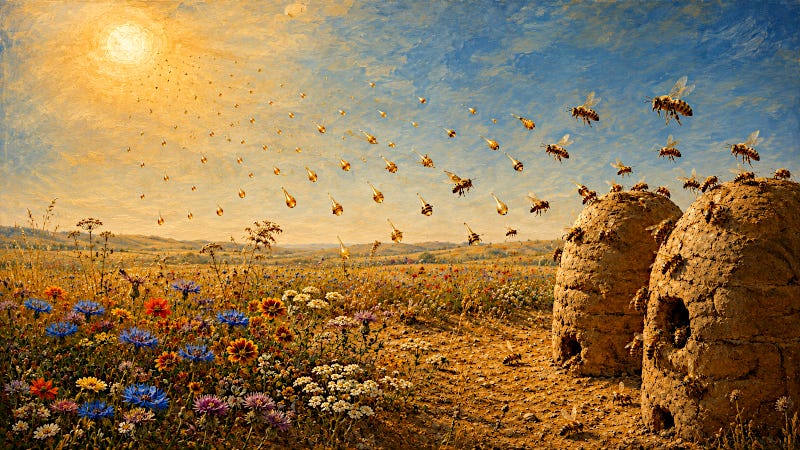
But There Is Another Side To This Story.
I have been speaking of the body’s intelligence with something approaching reverence — and I feel that reverence. The more closely I look at digestion, the more astonishing it becomes. But reverence brings responsibility.
I live in a neighborhood with many college students. I know something about what they eat because I see what is left behind: fast-food cartons, cups, wrappers, brightly printed remnants scattered along the street.
They are young. Youth is generous for a while. The body can carry an enormous amount of contradiction and continue forward. But I sometimes look at those wrappers and wonder about the heap given to these young bodies to sort.
Not because an occasional hamburger or soda is a moral failure.
Not because there was some pristine dietary past to which everyone should return.
The Question Is More Interesting Than That.
Human digestion is ancient. Our appetites are ancient.
The organisms living with and within us are ancient.
But much of the food environment now surrounding us is remarkably new.
Foods can be engineered for intensity, convenience, shelf life, texture and color — and to keep us reaching for more. Some products now occupy a curious territory between food as nourishment and food as manufactured product — edible, certainly, but increasingly difficult to trace in imagination back to field, orchard, animal, root or seed. Perhaps this is part of the sadness I sometimes feel: a broken lineage between the living world and what we have come to call food.
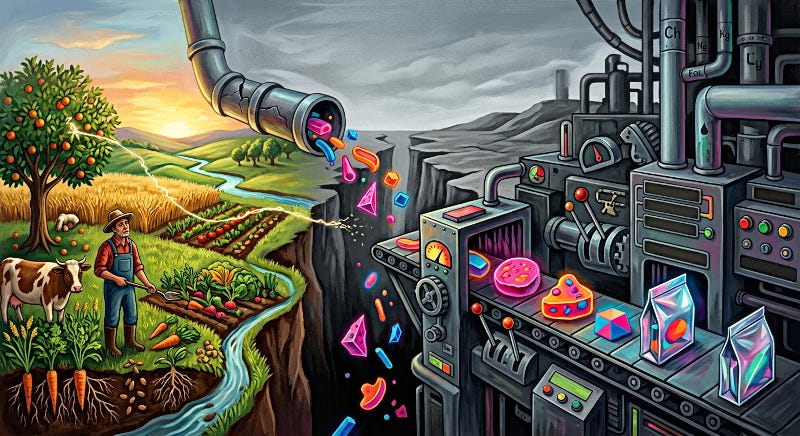
Eating can become detached from season, place, hunger, preparation — from the relationships that once made the lineage of food visible.
And so discernment cannot belong only to the intestine. Something must happen before the mouth. Psyche, too, is learning to sort.
The body’s small intelligences must work with what arrives. This is where viveka becomes more than a beautiful philosophical word.
What Am I Looking At?
Is It Food?
Is It Nourishment?
Are Those Necessarily The Same Thing?
What appetite is being answered here? Hunger speaks from the body’s need for nourishment, while appetite may speak with many voices. Is this hunger — or something else? The senses seeking pleasure, habit keeping its appointed hour, a longing for comfort, an attempt to soothe or numb a feeling we would rather not feel?
And Whose Appetite Is It?
There is no simple purity in these questions. An apple can nourish one person and trouble another. A celebratory meal can nourish in ways no nutrient table can measure. Hunger changes everything. Economics changes everything. Culture, access, time, loneliness and pleasure belong at the table too.
Discernment is not judgment. It is attention sufficiently intimate to perceive relationship. And I wonder whether this is one of the more difficult conditions of modern appetite:
Our Powers Of Discernment Now Live Inside An Environment Designed, In Part, To Capture Our Attention And Stimulate Our Wanting.
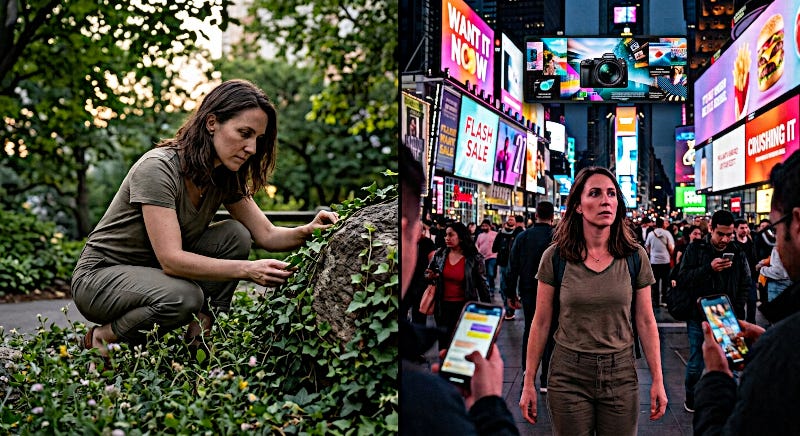
Psyche receives one impossible heap. The ants sort it. But what happens when the heap is continually replenished? Late-night eating, grazing without hunger, highly palatable foods that keep us reaching, portions beyond hunger.
There is something poignant in contemplating the body’s extraordinary resilience while continually adding to the heap. Yet resilience is not inexhaustible.
But who tends the threshold? Who teaches a young person to distinguish hunger from stimulation, nourishment from mere consumption, appetite from advertising?
Who Teaches Any Of Us?
I think about the young bodies passing my house, still possessing so much resilience. And I think, too, about the profound distress being reported among younger generations.
I would not reduce that suffering to food. Human beings are far too mysterious, and suffering far too complex, for such an equation. But neither do I want to pretend that the body is irrelevant to the life of the mind.
We Are Embodied Creatures.
Sleep, movement, sunlight, companionship, food, belonging, fear, pleasure, isolation — all enter the mysterious ecology from which a human life emerges.
So perhaps the question is not whether food explains our suffering. Perhaps the question is simpler:
What Conditions Are We Giving Life In Which To Flourish?
Psyche was given an impossible heap. The ants came to help her. And this returns the task to our own hands.
Before digestion comes selection. Before selection comes appetite. And between appetite and action lies the possibility of attention. Before the ants begin their miraculous sorting, someone places something on the heap.
What Are We Placing There?
Appetite
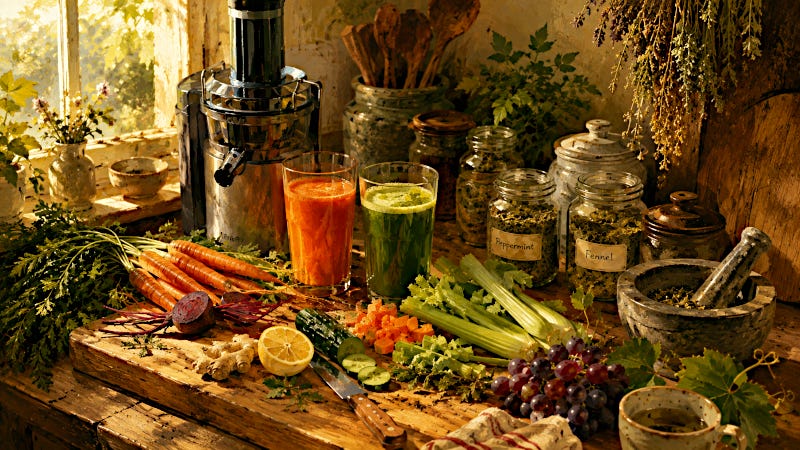
We usually imagine eating as something we do to food. But digestion is something the body does to the world. And appetite stands at the gate.
There are appetites of the body, certainly. But appetite also carries memory, loneliness, habit, pleasure, belonging, stimulation, comfort.
There are things we hunger for because they nourish us. There are things we hunger for because we have learned to hunger for them.
And Perhaps There Are Things We Consume Because We Do Not Yet Know What Else To Do With The Wanting.
Here Psyche returns. Her heap is not evil. The seeds do not need to be purified of their seedness. The barley is not morally superior to the millet. The lentil is not at war with the wheat.
The Task Is Recognition. What’s In The Pile?
This is this. That is that.
Each according to its kind.
What an exquisite image for discernment.
Not rejection. Not purity. Not control. Relationship.
Perhaps this is why the intestines belong so beautifully in the Virgoan imagination. The body itself is continuously sorting, selecting, absorbing, transforming, eliminating.
It does not keep everything. Nor does it reject everything. Life moves through both. Taking in. Letting go.
Virgo Moonth
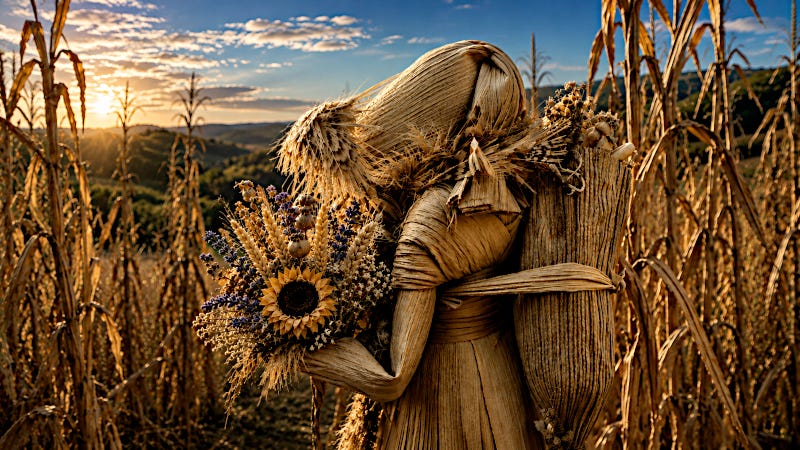
So Perhaps The Invitation Of Virgo Is Quieter Than Purification. Perhaps It Is Simply:
Pay Attention. What Is Here?
What Kind Of Thing Is It?
What Happens When I Take It In?
What Can Become Part Of Me? What Cannot?
And What Has Completed Its Passage And Needs To Be Released?
There is the food on our plates, and there is what life places before us each day. Both must somehow be digested.
We take in images, conversations, histories, griefs, ideas, other people’s desires. We inherit ways of seeing before we know that we have inherited them.
Some nourish. Some pass through. Some remain in us for years awaiting recognition. So I find myself returning to Psyche’s impossible heap.
Which Appetites Nourish? Which Merely Compel?
Which Voices Belong To Me?
Which Have I Swallowed From Somewhere Else?
What Shall Be Assimilated? What Shall Pass Away?
Psyche cannot answer by standing over the heap and thinking harder. The ants have to come.
Return
I circle back to the farm. Not because the past was pure. It wasn’t. Not because everything old was wise, or everything modern is mistaken. But because somewhere in my earliest memory is an experience of food before I had so many ideas about food.
Soil. Season. Animal. Vegetable.
Hands. Table. Hunger. Eating.
Perhaps what I remember most is relationship. And perhaps that is what Earth Medicina asks me to recover — not some imagined state of purity, but intimacy with the exchanges that are already taking place.
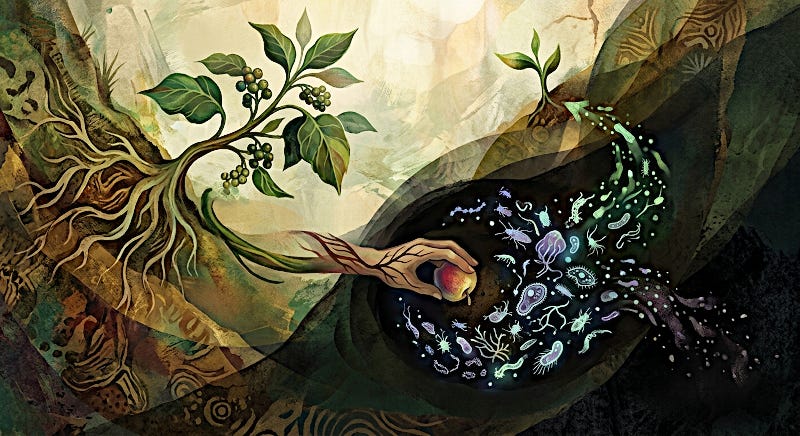
Earth becoming plant. Plant becoming food.
Food entering darkness.
The innumerable small intelligences gathering around it.
Sorting. Recognizing. Transforming.
Taking what can become life.
Releasing what cannot.
We call this digestion because we have to call it something. But sometimes, when I contemplate what is actually happening, the ordinary word seems inadequate. Somewhere inside us, Psyche’s ants are still at work.