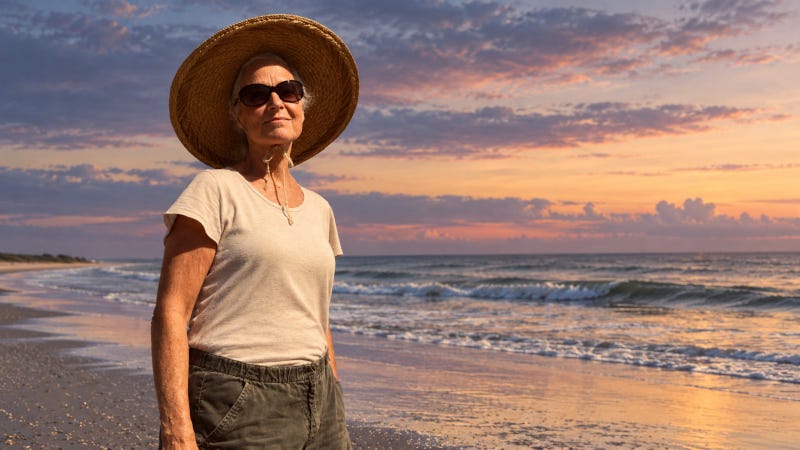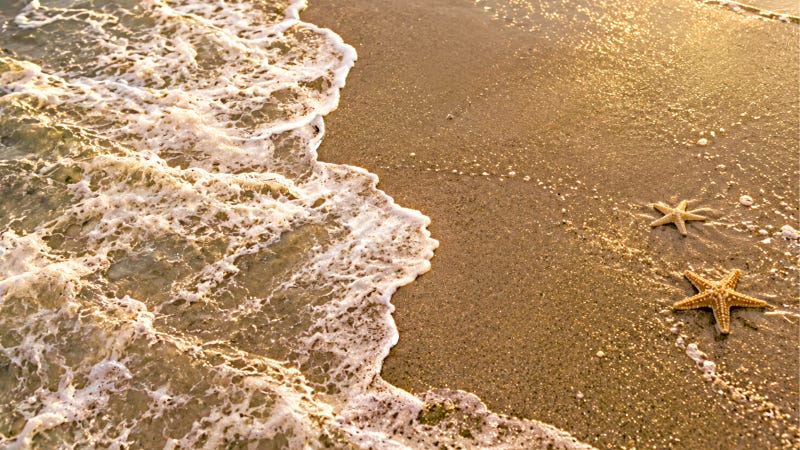
It was early one golden morning that I found myself once again wading in the water along the shoreline, walking toward a sunrise spanking the sea with sparkle. The tide was out. A faint breeze breathed in tandem with the gentle bowling waves.
I Paused In The Stillness And Noticed, There In The Now, A Moment.
The tongue and last lap of a delicately white-laced wave glided forward, stretching to its ultimate distance. For an instant it seemed to hover there, its fine edge curling across the wet sand, until the last softly crackling foam succumbed to the shore while the rest began its return — receding the distance it had come, disappearing again into the next break.
And There It Was.
For no more than a breath or two, sea and sand had drawn a figure together: one yielding into the other, one advancing as the other received, a curling line of white between them.
It Looked Like A Yin-Yang.

Not the familiar black-and-white symbol painted into a perfect circle, but something living and unfinished—drawn by water, erased by water. The sea had come as far as it could come. Some part of it remained behind, surrendered into the thirsty sand. The rest returned to itself.
Another wave gathered.
And I wondered whether balance had ever meant stillness at all.
A movement had reached its limit, and another movement had already begun.
The sea comes forward. The sand receives it. The water stretches itself almost impossibly thin until there is that exquisite lacework at the edge.
And Then Something Happens.
Some of the water surrenders into the sand. Some of it returns to the sea.
Almost as if to say: balance is not a position. It is a moment of exchange.
Nature holds its equilibrium dynamically. Day overtakes night; night overtakes day. Breath fills and empties. Weight transfers from one foot to the other. Relationship itself works this way: I approach you, yet retain myself. I yield something; I take something back.
Within the dark is the seed of light; within the light, the seed of dark. Complementary forces continually move toward, respond to, and transform one another.
A Boundary, Then?
Or A Wall?
The shoreline is one of the most intimate boundaries imaginable. Sea and land meet there continuously. They penetrate one another, reshape one another, leave their marks upon one another — and yet neither becomes the other.
Perhaps that is what a true boundary does.
It does not prevent encounter.
It makes encounter possible.
What Happens When The “Other” Is Not Sand, But Another Human Being?
How Great Was I?
I Moved On Impulse.
I Said It Out Loud!
I Struck A Blow!
There can be exhilaration in the unrestrained expression of self
— The Force of I Am, I Want, I Will.
Until, perhaps quietly and sometimes painfully, we discover the Rose.
A soft remorse arises for having hurt the innocent. There is a part of us that suffers when our power has injured something tender.
The Other Is Real.
You Exist Too.
And Suddenly Another Question Enters The Room:
What happened between us?
What was absorbed into the sand?
What did I leave there that I cannot simply gather back into myself?
Perhaps this is where strength encounters its own reflection.
Can strength remain strong without becoming cruel?
Can tenderness remain tender without becoming weak?
There may be no answer in choosing one over the other. Again and again, life brings them into relationship: the thorn and the blossom, assertion and reception, self and other, the wave advancing and the shore receiving.
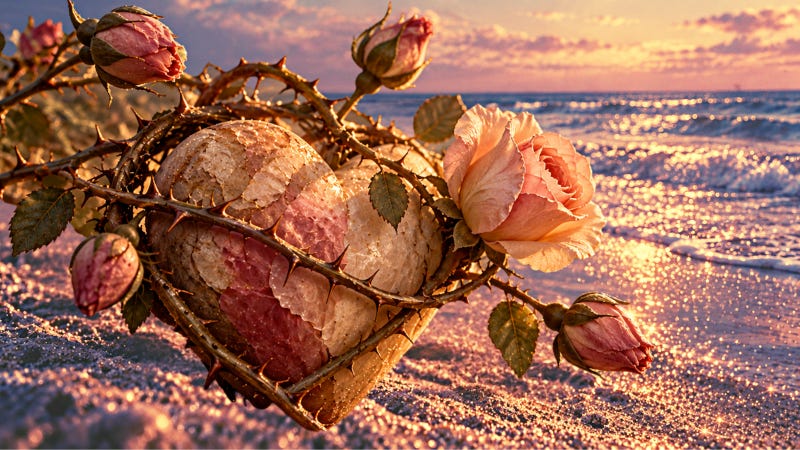
And somewhere in that delicate white lace at the very edge of the wave, each discovers the shape of the other.
Perhaps The Rose Was Never Without Its Thorns.
Another Image Comes To Me Now: A Heart Encircled By Them.
Not a wounded heart exactly, nor an innocent one. A heart at some station along the long road of becoming human. The Rose had awakened us to tenderness; the thorns tell us something of what we spend and what it may cost to remain tender.
And yet something tender has survived.
Perhaps tenderness is not what we possessed before the world hardened us. Perhaps it is what becomes possible after we have known our strength, used it badly sometimes, suffered the strength of others, and discovered that the Other is real.
You Exist Too.
Your Tenderness Exists Too.
And perhaps this thorned heart marks something humanity itself is still working through — a difficult station on a road of sacrifice toward whatever we may yet become.