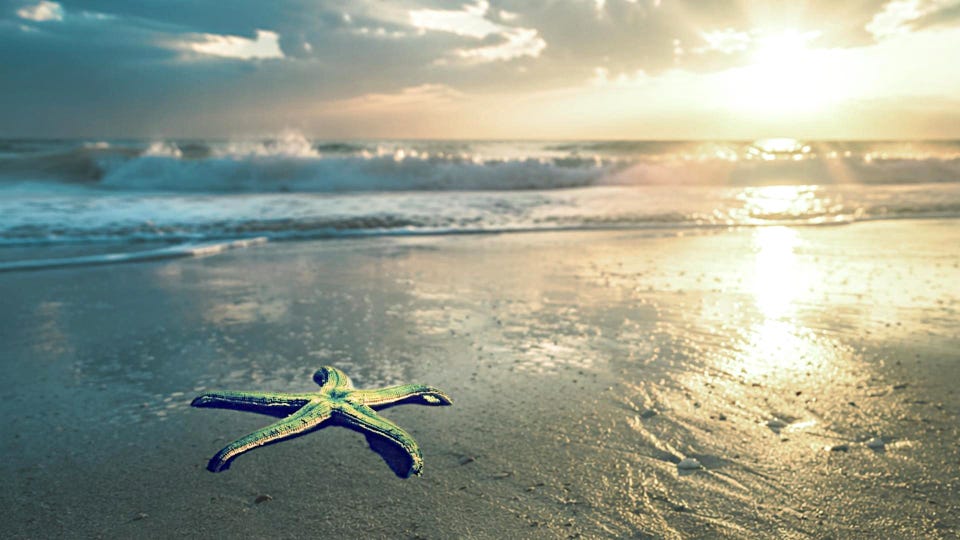
Perhaps There Are Always Two Baptisms In A Human Life — The First By Water, Where We Are Received Into Life.
Life Does Not Begin With Identity, But With Belonging.
Before any voice declares “I Am,” there is a subtle knowing: I Am Held — Carried, Touched, Kept Close.
At first there is very little I am. There is mostly I want — a reaching, a hunger, a cry that brings the world near.
And Perhaps That Is How Life First Teaches Us: “I Exist.”
We are born as softness — yielding, impressionable, open — skin to skin with the world, taking it in before we understand it. The nervous system carries faint threads of ancestral memory, though they rest quietly in this new beginning.

The newborn is not yet ego, but life itself — emerging from the ocean of the mother into what may later be called the great battlefield of living, full of potential, but without direction.
This Is The First Baptism. A Baptism Of Water. A Consciousness That Is Communal, Pre-Defined, And Immersed In Relationship.
We belong before we become. And then, there is a second baptism — a baptism of fire. If the first teaches us that we belong to life, the second asks who we are willing to become within it.
Fire introduces separation, identity, and will — the moment we begin to feel ourselves as someone, standing slightly apart from the world that once held us.

Before we learn to become, we learn to imagine — to try on selves, to stretch into what might be.
Before We Compete, We Play.
And then, almost imperceptibly, we begin to measure — to see ourselves as seen, to weigh, to compare — to notice who runs faster, who is praised, who is chosen. What was once discovery gathers a question beneath it. Somewhere along the way, the question begins to change from “What Can I Discover?” to something quieter, more pressing: “Am I Enough?”
When this shift comes too early, something subtle tightens — a hesitation, a holding back where there was once ease. Belonging begins to give way to evaluation. Exploration becomes performance.
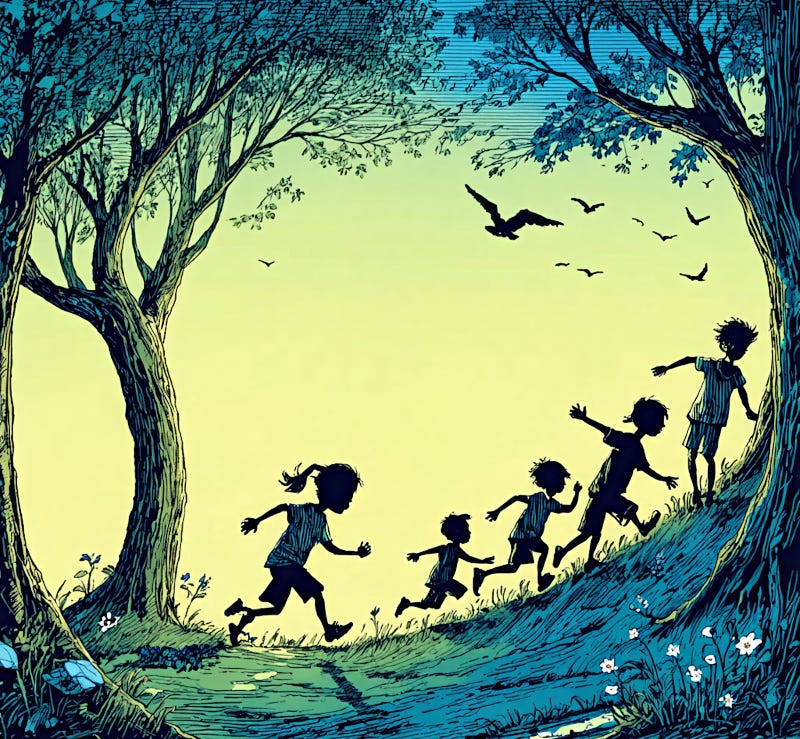
But when there is time — time to play, to wander, to try on selves without consequence — to move, to fall, to try again without keeping score — identity forms with more room to breathe inside it.
Competition has its place. It can reveal strength and refine skill. But perhaps it belongs to a later fire — one that emerges after belonging has taken root.
Belonging Before Becoming
And even then, the fire does not arrive gently. It asks something of us — something we cannot quite refuse. Not that we win — but that we stand — carried, at first, by what once held us.
Perhaps the true baptism of fire is not learning how to win, but learning how to stand within oneself — whether winning or not.
To Stand At All Is Something Learned — And Something Given!
Once, we were lifted.
Then we stood — unsteady, astonished.
Then we walked.
And often, we fell.
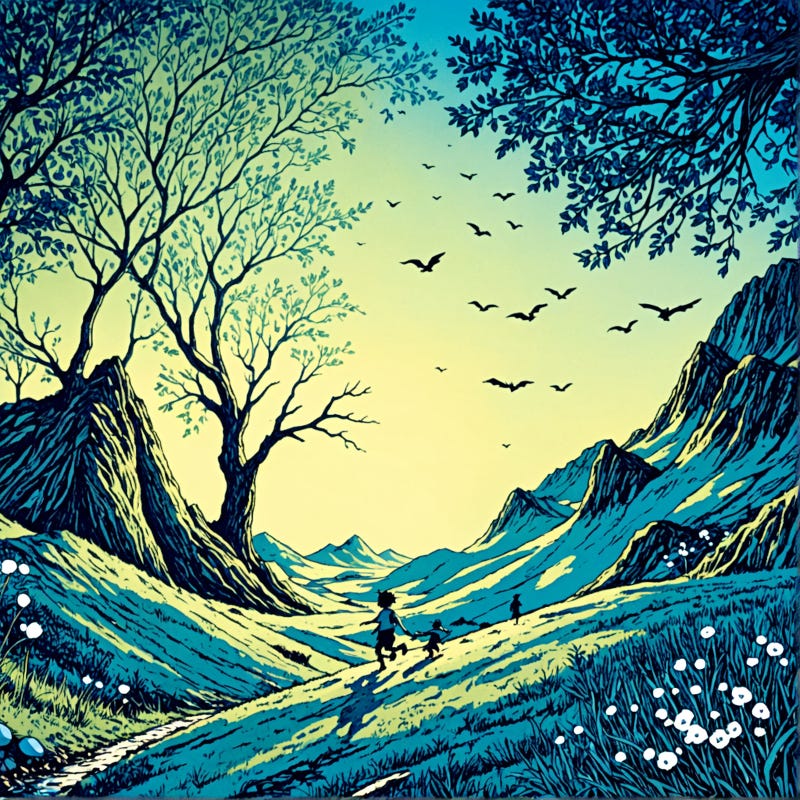
But falling was not yet failure. Already, the world was beginning to notice — to celebrate, to encourage, to lean us, gently, toward becoming. And sometimes, without meaning to, that encouragement gathers volume — a cheering that begins to shape the moment, that asks not only that we rise — to step forward, to be seen — but that we shine for the watching world in ways that begin to resemble performance — almost without our noticing — before we have found our own way to stand.
Something in us kept rising — and we kept finding our feet — not by force, but by a kind of subtle insistence of life itself — an inner allegiance that did not waver. And so — we rose again and again — often with glee.
Somewhere along the way, the nature of that rising changes.
It is no longer about being seen rising, but about knowing how to stand — steady on one’s own ground.
It is not that we conquer — but that we come to know the ground of our own being.
The fire clarifies. It burns through false certainty, borrowed identities, and the need to appear whole before we are ready. And in that burning, something unexpected happens, Not destruction — but lightness.
The self we thought we had to defend begins to loosen — its grip softening, its edges less fixed. The need to define ourselves softens. And what remains is not emptiness, but presence.
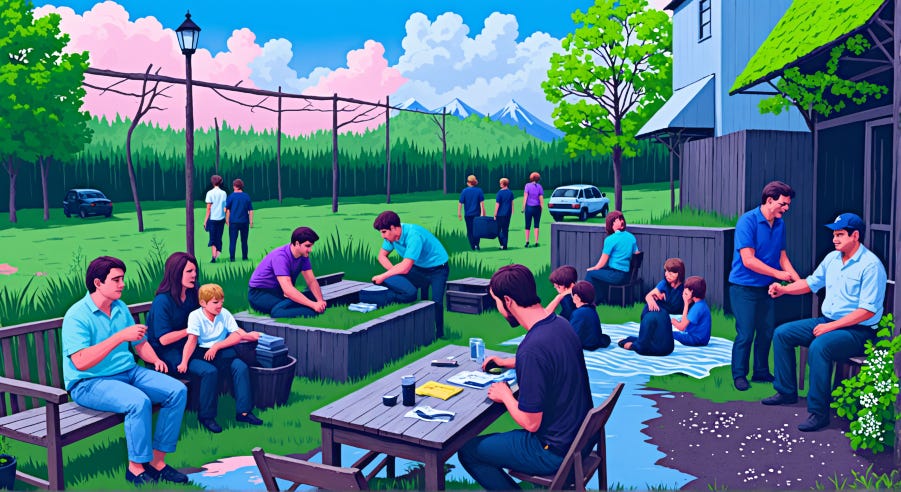
Perhaps This Is The Quieter Meaning Of Transformation: Not Becoming More, But Becoming More True.
These movements are not only personal. When belonging feels uncertain, competition intensifies — we push harder, compare more, try to secure our place. When identity feels fragile, power struggles emerge. And what looks like strength can sometimes be fear, hardened into form.
Perhaps humanity, too, is learning the difference between power and maturity. And yet, even as the collective temperature rises, another force persists, quietly...
Resilient…
Unassuming…
Not Dramatic…
But Everywhere…
In the continuity of ordinary lives — those who keep caring, creating, planting, teaching, healing — and beginning again, in the smallest ways. Perhaps resilience is the deeper fire — not the fire that conquers, but the fire that continues... There is, perhaps, a third baptism.
Not Of Water,
Not Of Fire,
But Of Spirit.
The fire does not end in spirit — it reveals it. It does not arrive with clarity, but with a kind of holy bewilderment.
The need to arrive somewhere dissolves. Time loosens its grip. And what once felt like wandering begins to feel like home. Not because we have arrived somewhere else, but because we are no longer trying to escape ourselves.

The Kingdom Is No Longer Elsewhere. It Is Here — Felt Beneath Our Feet.
And from this, something unexpected unfolds: not an escape from the body, but a return to it. The ordinary becomes luminous. The smallest details — a breath, a step, even the curve of a toe — carry the same significance once reserved for transcendence.
The Circle Closes…
We Enter Life Through Belonging.
We Define Ourselves Through Fire.
We Yield Again Into What Is.
If the first baptism teaches us we belong, and the second awakens us to ourselves, then maturity may be something quieter still — learning how to carry the fire without letting it consume us — or define us too quickly.
The Fire Is Given — And The Wisdom To Carry It Is Forged In The Living Of It.